

/image%2F0175369%2F201306%2Fob_941224ded65561048e2111bd62e2e55c_p1020984.JPG "Please wait while building science...")
Understanding equations
Publié le 26 Mai 2013
While reading scientific publications, most of people, including a large part of the physicists, do not read the equations, since they think they are unable to understand them. However, it is rather easy to understand and then develop a feeling on the most simple (then important!) effects during the first reading. Of course, there exists coupled effects which are difficult to guess, but we shall first start to identify the obvious behaviours first. For that point, I propose several pictures which allow an easy understanding.
The first task is to identify the type of differential operators. Is there a time derivative in the equation ?
\[ \frac{\partial}{\partial t} \]
Are there spatial derivatives in the equation ?
\[ \frac{\partial}{\partial x} \]
If the answer to both questions is "YES", then we are in presence of an evolution partial differential equation. It means that the described quantity, let's call it $u$, evolves as a function of time and as a function of space.
Once we have identified the space and time coordinates, then we can refer to the picture to understand the simplest effects described by these differential operators.
We can obtain diffusion effects, where the quantity $u$ is spread into a larger space while the time is increasing. We can also obtain a convective effect, where the quantity $u$ is moved with a velocity generally described by the additional coefficients.
Thereafter, the functions caracterizing the quantity $u$ depends on the order of time and space derivatives.
On the following figure,
Fig. 1 presents the "convective transport" of a quantity $u$ with a velocity $c$.
Fig. 2 presents the "diffusive transport" of a quantity $u$. The coefficient $D$ is named "diffusion coefficient" and represents the increasing coverage area per time unit.
Fig. 3 presents another type of "convective transport" of a quantity $u$ with a velocity $c$. This equation is known as "wave equation". The main difference with the convection of Fig. 1 is the type of functions used to describe the convective transport behaviour. In the case of Fig. 1, the transport is described using real exponents. In the case of Fig. 3, the transport is described using trigonometric functions.
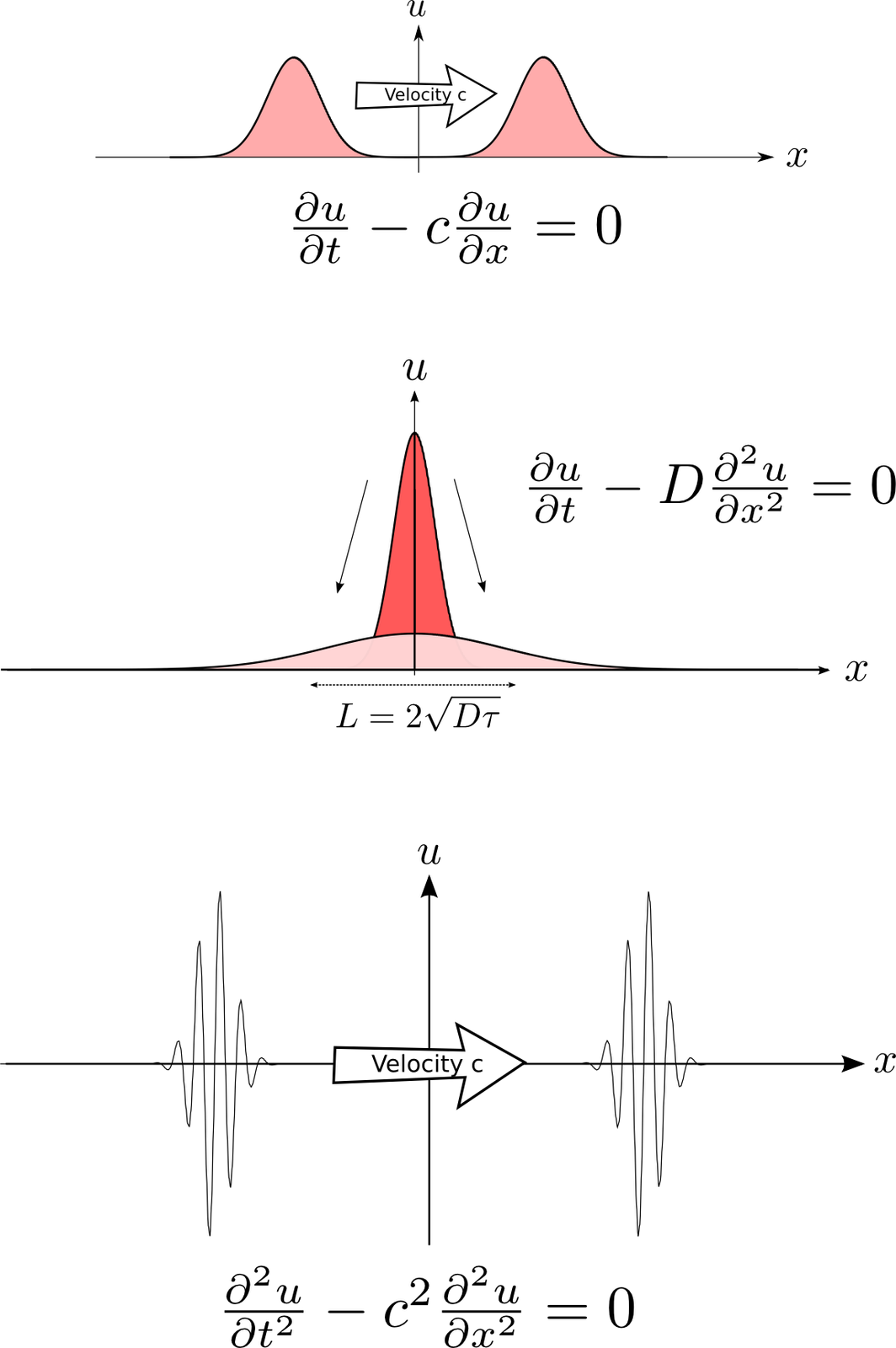
Typical behavior of a quantity $u$ modelized by partial differential equations (PDEs).